INDEPENDENT AI ENGINEERING PROJECT #4
Decisions you can explain.
Evidence you can inspect.
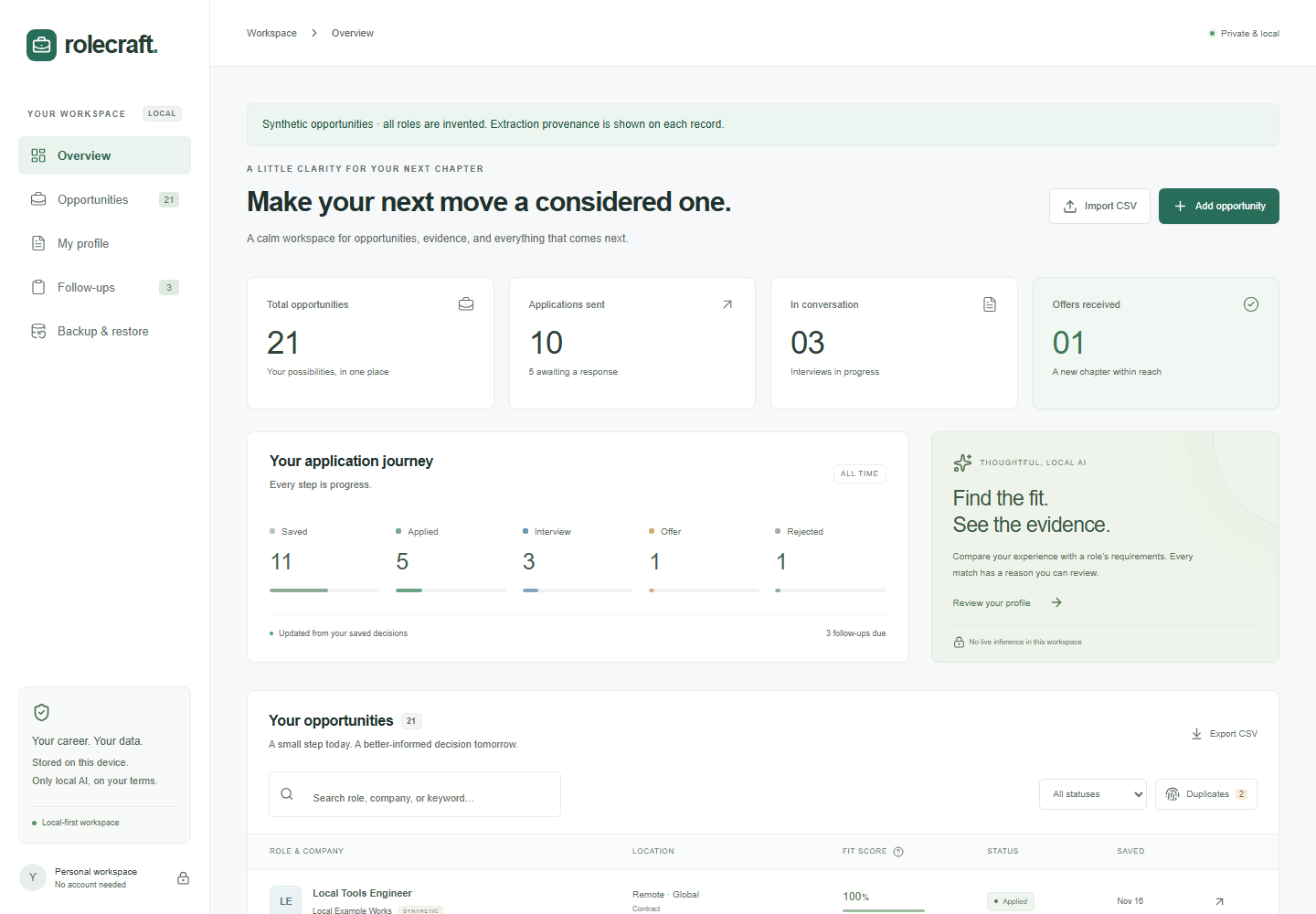
Rolecraft helps a person organize opportunities, compare their actual experience with a supplied role, and track what happens next. Its engineering priority is making model claims inspectable while keeping private résumé information on the user's machine.
The product problem
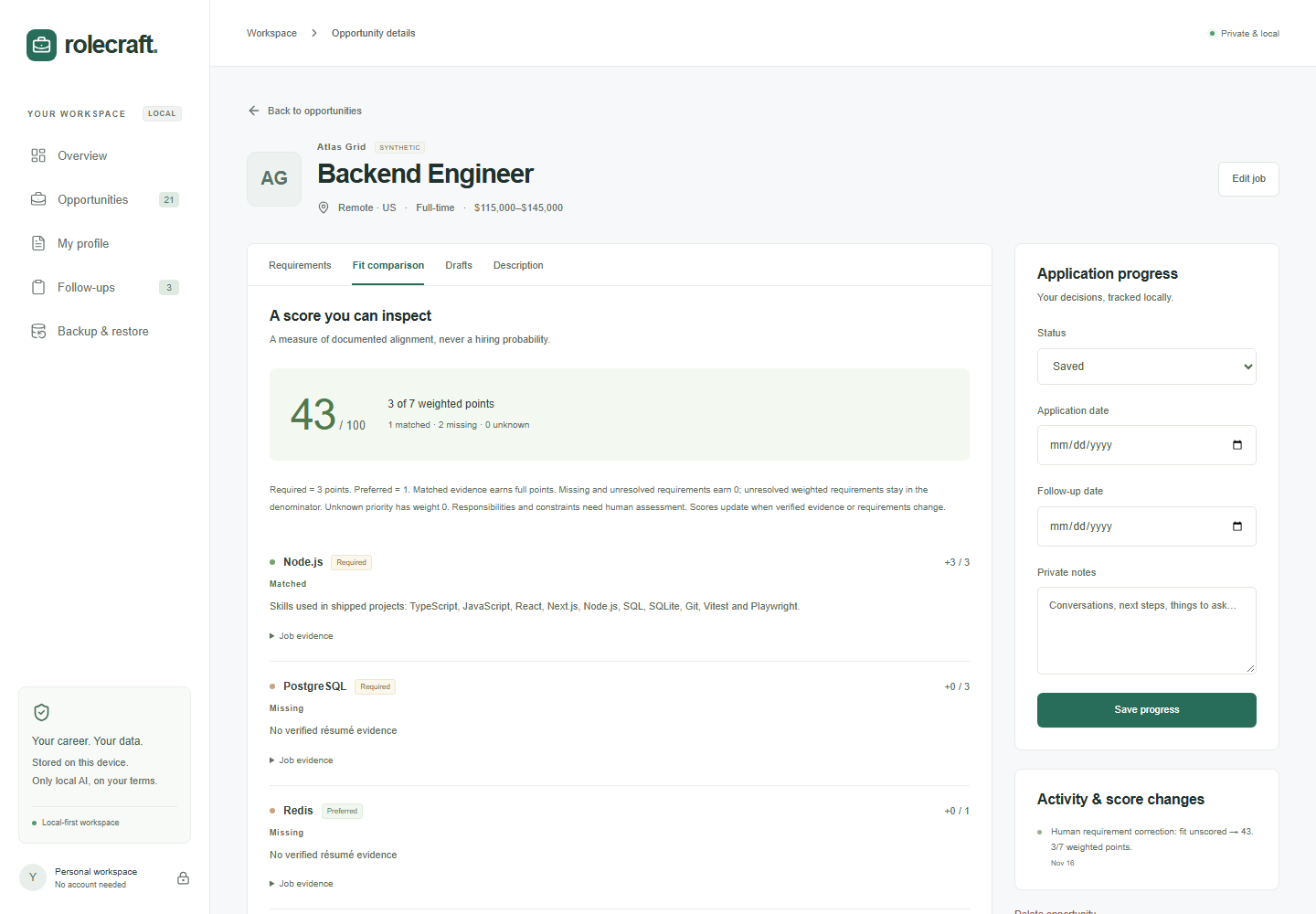
A collection of saved vacancies becomes useful when requirements, candidate evidence and application history are connected. A model-generated score alone is not enough: people need to know which requirements are explicit, which skills are missing, where evidence is uncertain, and what a human has reviewed.
The local implementation
- INTERFACENext.js / React / TypeScriptImport, evidence forms, transparent comparisons, tracking and human-approved draft templates.
- PERSISTENCELocal SQLitePrepared statements, WAL, migration metadata, transactions and explicit recovery.
- INFERENCEOllama / Qwen3 4BBounded job-only inference through a dedicated server adapter. No paid or remote fallback.
- VALIDATIONZod + exact source evidenceFail-closed contracts and semantic rejection, with retained provenance and human review.
Résumé evidence is extracted by deterministic local rules and reviewed by the user. Matching is a reproducible calculation: required requirements weigh 3, preferred requirements weigh 1, and unknown priorities weigh 0. The UI shows earned points, missing skills and unresolved constraints. A fit score is documented alignment, not a hiring probability.
Cover-note drafts are deterministic templates assembled from documented skill matches. They are not AI-generated prose. The local application permits editing, requires explicit approval, and supports manual copying; it never sends messages or submits applications.
What genuine verification established
The recorded local verifier passed actual Ollama/Qwen3 inference, HTTP response identity, successful completion, a strict Zod contract and exact source quotes. A complete local browser workflow also passed at its recorded baseline. The focused extraction correction reached 8/8 original application acceptance using five affected reruns and three retained controls. Its separately authored holdout reached 4/4 acceptance, 100% precision and 92.3% recall.
One supported Flask preference was omitted from the holdout. Application acceptance is not completeness, and a small synthetic suite is not a general benchmark. The local extraction implementation remains frozen. Publishing this showcase did not run further model evaluations.
- Genuine inference verification metadata ↗
- Quality metrics, retained controls and limitations ↗
- Local product and recovery acceptance ↗
Privacy and recovery are product features
The local workspace retains identifiers, source evidence, inference provenance, statuses and approved text. Backup uses SQLite's online backup procedure; restore validates an isolated file, requires an explicit preview and confirmation, and replaces records atomically. Backups are sensitive plaintext, capped at 32 MiB. Recovery tests include corruption, stale previews, concurrent activity and an abrupt process exit before commit.
A deliberately separate public surface
This site is an independently built static directory. It reuses the actual pure matching calculation and invented fixtures, but contains no production API, database connection, SQLite file, private résumé, model endpoint, upload or backup/restore service. Interactive tracking, review and approval are temporary client-side illustrations that reset on reload. No analytics, advertising or third-party runtime dependencies are included.
Run the complete local application
The actual application requires Node.js 24.15+ within 24.x. Local AI additionally requires Ollama and the installed Qwen3 4B model. No paid API key is needed. CPU inference often takes tens of seconds and may take up to five minutes.